
If you're dealing with a leaky ceiling or damaged shingles, Coquitlam roof repair is something you don't want to put off - especially in a climate that tests roofs year-round across the Lower Mainland. We're Red Maple Roofing, and we've been helping Coquitlam homeowners protect their homes from the relentless Pacific Northwest weather for years. We know how quickly a small issue can snowball into a full reroofing project when moisture gets under damaged materials. This guide walks you through exactly what you need to know about keeping your Coquitlam roof in solid shape.
Coquitlam sits in one of the wettest urban regions in Canada. That's not a complaint - it's a fact that shapes every roofing decision we make for our clients here. Unlike roofing in drier parts of BC, every material choice, every repair method, and every maintenance schedule we recommend is built around that constant moisture. Whether your home has asphalt shingles, cedar shakes, or a low-slope membrane roof, understanding how the local climate affects your roof is the first step toward protecting your biggest investment. We've put together this resource to help you make confident, informed decisions.
Understanding Coquitlam Roof Repair Needs: How the Coastal Climate Affects Your Home
Coquitlam's temperate rainforest climate is genuinely different from what homeowners experience in Vancouver's drier neighbourhoods or the BC interior. Annual rainfall in this region frequently exceeds 1,500 mm, and that moisture is persistent - it doesn't just fall in heavy bursts, it lingers as drizzle, fog, and humidity for weeks at a time. We've seen firsthand how that sustained dampness accelerates wear on roofing materials that might last decades in drier climates. Asphalt shingles lose their protective granule coating faster, cedar shakes swell and crack through repeated wet-dry cycles, and flat roof membranes are under constant hydrostatic pressure. Understanding this climate reality is what separates proactive roof maintenance from expensive emergency repairs.
Most Vancouver homeowners we work with are surprised to learn just how much the BC Building Code accounts for these conditions. Under BC Building Code Division B, Part 4, roofing systems must meet specific structural load and wind resistance calculations that are calibrated for coastal conditions. That's not bureaucratic fine print - it's the technical baseline that keeps your roof from failing during a winter windstorm. When we assess a Coquitlam roof for repairs, we're not just looking at surface damage. We're checking whether the underlying structure still meets those code requirements, because a repair that ignores the structural layer is just a temporary fix waiting to fail.
Proactive maintenance is, without question, the most cost-effective roofing strategy for Coquitlam homeowners. A professional inspection twice a year - once in late spring and once before the heavy November rains - gives you the opportunity to catch developing problems while they're still minor repairs rather than major reroofing projects. Our Coquitlam Roofing Services: 9 Proven Maintenance Steps article goes deeper into the specific maintenance tasks that matter most in this climate. Skipping those check-ups might seem like a money-saver in the short term, but in our experience, homeowners who skip regular inspections end up spending significantly more within five years. The damp climate simply doesn't give neglected roofs much grace.
Cedar roofing in the Lower Mainland deserves special mention here, because it requires a fundamentally different maintenance approach than cedar roofing in the BC interior. The RCABC Consumer Guide to Roofing specifically notes that cedar in the damp coastal climate needs regular treatment to prevent moisture absorption, splitting, and biological growth. In our experience installing and restoring cedar roofs across Coquitlam, a cedar shake or shingle roof that's properly maintained can last 30 years or more. But without treatment every three to five years, you're looking at a lifespan that's cut nearly in half. The wood simply doesn't stand a chance against 1,500+ mm of annual rainfall without some help.
"In our experience working on Coquitlam roofs, the homeowners who fare best aren't the ones with the newest roofs - they're the ones who schedule regular inspections and address small issues before the rainy season hits. A $300 repair in September can prevent a $12,000 reroofing project in January."
The Impact of BC Weather on Your Roof: 1,500mm of Annual Rainfall and What It Means
The numbers are worth sitting with for a moment. Coquitlam and Greater Vancouver regularly record annual rainfall exceeding 1,500 mm, making this one of the wettest metropolitan regions in North America. For comparison, London, England - famous for its grey skies - averages around 600 mm per year. What that means for your roof is a sustained, year-round assault on every seal, seam, and surface. Water finds its way into the smallest imperfections, and once it's under your roofing materials, it creates a chain of damage that moves from shingles to underlayment to roof deck to insulation to your home's interior framing. We've seen that entire progression happen within a single wet season when a repair was left unaddressed.
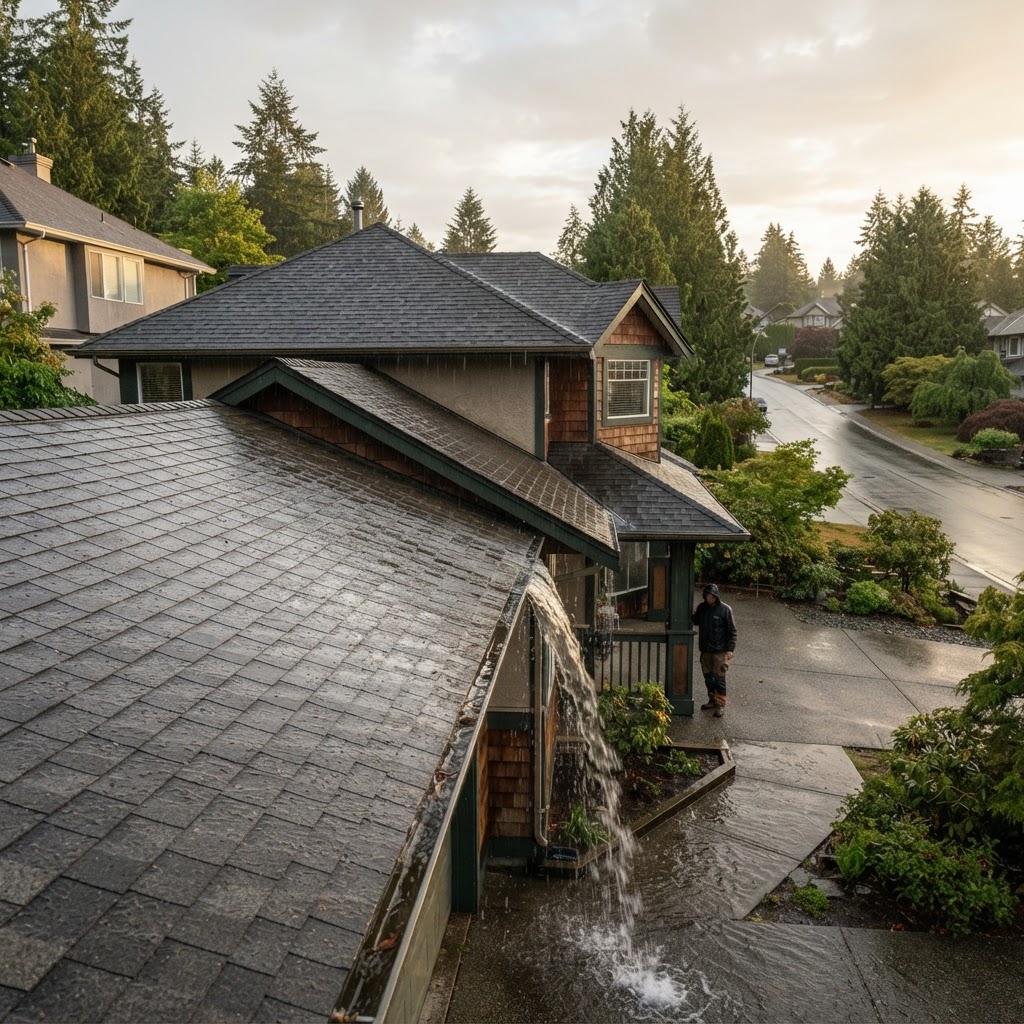
The structural component of your roof is where water damage gets most serious, and it's the part homeowners are least able to see. According to the RCABC Roofing Practices Manual on Roof Decks, roof decks must limit deflections to 1/240 of the total span and conform to BC Building Code requirements. For low-slope membrane roofs, a minimum plywood thickness of 12.7 mm (1/2 inch) is required. When water infiltrates a damaged roof and reaches the deck, that plywood begins to soften, delaminate, and rot - and a deck that no longer meets those deflection limits is a structural liability, not just a cosmetic problem. Replacing a deteriorated roof deck adds substantially to the cost of any reroofing project, which is precisely why catching moisture intrusion early matters so much.
Wind is the other major weather factor that Coquitlam homeowners need to understand. The region experiences significant wind events, particularly in fall and winter, and those gusts can lift or crack shingles that are already weakened by moisture. The VRA Standard in the RCABC Roofing Practices Manual outlines the wind load calculations that compliant roofing systems must satisfy under BC Building Code Division B, Part 4. In practical terms, this means that the fastening patterns, overlap dimensions, and material specifications used during installation or repair aren't arbitrary - they're engineered responses to the specific wind loads this region experiences. When we carry out a Coquitlam roof repair, we always verify that any replacement materials and fastening methods meet those code-mandated wind resistance standards.
Temperature cycling adds another layer of stress that's easy to overlook in a climate people associate primarily with rain. Coquitlam does experience freezing temperatures in winter, and the freeze-thaw cycle is particularly damaging to roofing materials that have already been softened or saturated by rain. Water that seeps under shingles or into small cracks expands when it freezes, widening those cracks and accelerating deterioration. Over several winters, this process can turn a minor surface issue into a significant structural repair. We always advise homeowners to have their roof inspected after any period of freezing weather - even a brief cold snap can reveal vulnerabilities that weren't visible before. For more detail on full replacement considerations, our Roof Replacement Vancouver guide covers the decision-making process in depth.
Common Signs You Need Coquitlam Roof Repair: What to Look For
Catching roof problems early is genuinely one of the most valuable things a Coquitlam homeowner can do. The challenge is that many of the early warning signs are subtle, and by the time damage is obvious from the ground, the repair scope has usually expanded significantly. In our experience, homeowners who learn to recognise the early indicators save thousands of dollars compared to those who wait until there's a visible leak or a ceiling stain. You don't need to climb up on the roof yourself - a pair of binoculars and a walk around the perimeter of your home can reveal a lot, and a professional inspector can catch the rest. Knowing what to look for gives you the confidence to act quickly rather than waiting and hoping the problem resolves itself.
Here are the seven most common warning signs that your Coquitlam roof repair needs are becoming urgent. These are the indicators our team looks for during every inspection, and they represent the full range of issues we encounter on Coquitlam homes:
- Missing or cracked shingles - even one or two missing shingles expose the underlayment and deck to direct rainfall and UV degradation.
- Granule loss in gutters or downspouts - asphalt shingles shed granules as they age, and heavy granule accumulation in your gutters signals that the shingles are approaching end of life.
- Sagging or uneven roof sections - these indicate moisture damage to the roof deck or structural framing below, which requires immediate professional assessment.
- Dark staining or streaking on shingles - often caused by algae or early-stage moss growth, this staining weakens the shingle surface and can spread rapidly in Coquitlam's damp climate.
- Visible daylight in the attic - if light is coming through the roof boards when you check your attic, water certainly can too.
- Peeling or bubbling paint near roofline - this often signals poor attic ventilation or moisture infiltrating behind the fascia boards.
- Interior ceiling stains or water marks - by the time water appears inside your home, the damage pathway through your roofing system is already established and needs urgent attention.
Sagging areas deserve particular attention because they're the one warning sign that indicates potential structural failure rather than just surface deterioration. We've seen firsthand how a sagging roof section can progress from a minor deck softening issue to a collapse risk if heavy snow loads arrive before repairs are made. If you notice any area of your roof that looks lower or more flexible than the surrounding surface, that's a situation that calls for a professional inspection within days, not weeks. The RCABC Consumer Guide to Roofing recommends that homeowners seek qualified, licensed roofing contractors for any structural assessment, and we strongly agree with that guidance. Don't attempt to walk on a suspected soft spot - contact a professional immediately.
Interior signs of roof damage - ceiling stains, water marks around light fixtures, or dampness in the attic - are the final stage of a failure chain that started at the roof surface. By the time water reaches your living space, it has already moved through the shingles or membrane, the underlayment, and the roof deck. That multi-layer penetration often means repairs are more extensive than they would have been if the issue had been caught earlier. If you're noticing any of these interior signs, we'd encourage you to reach out for a free quote as soon as possible. Our team can assess the full extent of damage and give you an honest picture of what the repair scope looks like. For urgent situations, our Emergency Roof Repair Services guide outlines the steps to take when you need help fast for Coquitlam Roof Repair.
Moss Treatment and Prevention: Protecting Coquitlam Roofs from Biological Growth
Moss is one of the most common and most underestimated roofing problems in Coquitlam. The combination of shade from mature trees, persistent humidity, and minimal frost creates near-ideal conditions for moss to colonise both asphalt and cedar roofing materials. We've seen roofs where moss coverage was so thick it looked like a green lawn from the street - and underneath that appealing appearance was significant moisture damage to the shingles. Moss retains water against the roof surface for extended periods after rainfall ends, dramatically accelerating the deterioration of both asphalt granules and cedar fibres. What begins as a cosmetic issue becomes a structural one if it's left unaddressed through multiple rainy seasons.

The mechanism of moss damage is more destructive than most homeowners realise. Moss anchors itself to roofing materials using root-like structures called rhizoids, which physically penetrate the surface of asphalt shingles and cedar shakes. On asphalt, this accelerates granule loss and creates pathways for water infiltration. On cedar, the rhizoids break down the wood fibres directly, softening shakes and making them prone to cracking and splitting during freeze-thaw cycles. The moisture retained by moss colonies also keeps the roof surface in a perpetually damp state, which promotes the growth of lichens and algae alongside the moss - a compounding biological assault on your roofing materials. Regular professional moss treatment interrupts this cycle before the biological growth has a chance to cause lasting structural damage.
Effective moss treatment for Coquitlam roofs involves more than just brushing off the visible growth. In our experience, mechanical removal alone - scraping or pressure washing the surface - can actually cause additional damage if done aggressively, and it doesn't address the underlying conditions that allowed moss to establish in the first place. A proper professional treatment uses appropriate biocidal solutions applied at the right concentration, followed by a preventative treatment that inhibits regrowth for several years. We also recommend zinc or copper ridge strips as a long-term prevention measure, because the metal ions that wash down the roof surface during rainfall create an environment where moss struggles to establish. For a detailed look at what professional moss treatment involves, our Expert Commercial Moss Removal Vancouver BC article covers the full process.
Prevention is genuinely easier and cheaper than remediation when it comes to moss. Trimming back overhanging branches to increase sunlight exposure and improve airflow across your roof surface makes a measurable difference in how quickly moss re-establishes after treatment. Keeping gutters clear of debris - which we cover in detail in our Gutter Cleaning Vancouver guide - is equally important, because blocked gutters create standing water conditions at the roof edge that accelerate moss growth at the eaves. We recommend that Coquitlam homeowners schedule a moss inspection as part of their annual roof maintenance routine, particularly after the summer months when growth tends to be most vigorous. Combining regular inspections with timely treatment is the most effective way to extend the lifespan of your roofing materials in this damp climate. Check our services page to learn more about the full range of roof maintenance options we offer Coquitlam homeowners.
Gutter Cleaning and Repair Essentials
Most Vancouver homeowners we work with don't realise just how much their gutters influence the overall health of their roof. Blocked gutters are one of the leading causes of water ingress we see during Coquitlam roof repair calls. When gutters fill with debris, pine needles, and compacted moss, water backs up under the eaves and begins saturating the fascia boards, soffit, and eventually the roof deck itself. Given that Coquitlam and the surrounding Lower Mainland receive annual rainfall well in excess of 1,500 mm, a drainage system that's even partially blocked can cause serious damage in a single storm season. We've seen fascia boards so thoroughly rotted from chronic overflow that they required complete replacement before we could even address the roof membrane beneath.
Gutter cleaning is not simply a cosmetic task - it's a structural maintenance requirement for any home in our climate. We recommend Coquitlam homeowners schedule professional gutter cleaning at least twice a year: once in late spring after the cottonwood and maple seeds have fallen, and again in late autumn after the deciduous trees have shed their leaves. Homes surrounded by conifer trees, which are extremely common throughout Burke Mountain and Westwood Plateau, often need a third clean during summer. A thorough clean should include flushing the downspouts with a hose to confirm water is flowing freely to the street or storm drain, not pooling at the foundation. If you want a deeper look at what proper gutter maintenance involves, our post on Gutter Cleaning Vancouver: 7 Essential Tips for Home Protection walks through the full process in detail.
Beyond cleaning, gutters themselves wear out and need periodic repair or replacement. Common issues we diagnose include sagging sections where the hanger brackets have pulled away from the fascia, open mitre joints at corners that spray water directly onto the siding, and downspout elbows that have disconnected and are directing water toward the foundation. Seamless aluminium gutters are the most practical option for most Coquitlam homes because they eliminate the number of joints where leaks can develop. During any Coquitlam roof repair inspection, our team always checks the gutter profile and pitch - gutters should slope at roughly 6 mm per 3 linear metres toward the downspout to drain properly. If the slope has shifted due to ice loading or bracket failure, even a clean gutter will hold standing water and create a breeding ground for mosquitoes and additional moss growth near the roofline.
- Clear gutters of leaves, moss, and debris at least twice annually - more if conifers surround your home
- Flush downspouts from the top to confirm unobstructed flow all the way to the drain
- Inspect fascia boards for soft spots, discolouration, or paint bubbling - these signal moisture damage behind the gutter
- Check all gutter hangers and resecure any that have pulled away from the fascia board
- Ensure downspout extensions direct water at least 1.5 metres away from the foundation
- Look for rust staining or watermarks on siding directly below gutter seams - a sign of joint failure
Navigating the BC Building Code for Coquitlam Roof Repair
One of the most common questions we hear from homeowners is whether a roof repair requires a building permit. The honest answer is: it depends on the scope of the work. Straightforward shingle replacements on the same surface typically don't require a permit in Coquitlam, but any work that involves structural alterations, changes to the roof deck, or full reroofing projects often does. The BC Building Code, specifically Division B, Part 4, governs structural load and wind resistance calculations for roofing systems throughout the province. Ignoring these requirements isn't just a regulatory risk - it's a safety one. We always advise homeowners to check with the City of Coquitlam's building department before beginning any significant roofing project. You can also read more about Understanding the BC Building Code for roofing directly from the RCABC Roofing Practices Manual.
Wind load calculations are a non-negotiable part of any compliant roofing project in our region. The BC Building Code requires that roofing systems be engineered to resist the specific wind pressures calculated for their location, which vary across Metro Vancouver and the Fraser Valley. The VRA Standard in the RCABC Roofing Practices Manual outlines exactly how these calculations must be performed and documented for low-slope membrane and steep-slope systems alike. In our experience installing and repairing roofs across Coquitlam, Burke Mountain properties at higher elevations are particularly exposed to gusting winds that can lift poorly fastened shingles or membranes if the correct nail pattern and fastener specifications aren't followed. Using the right fasteners at the right spacing isn't a suggestion - it's a code requirement that protects your home and your neighbours' property during a windstorm.
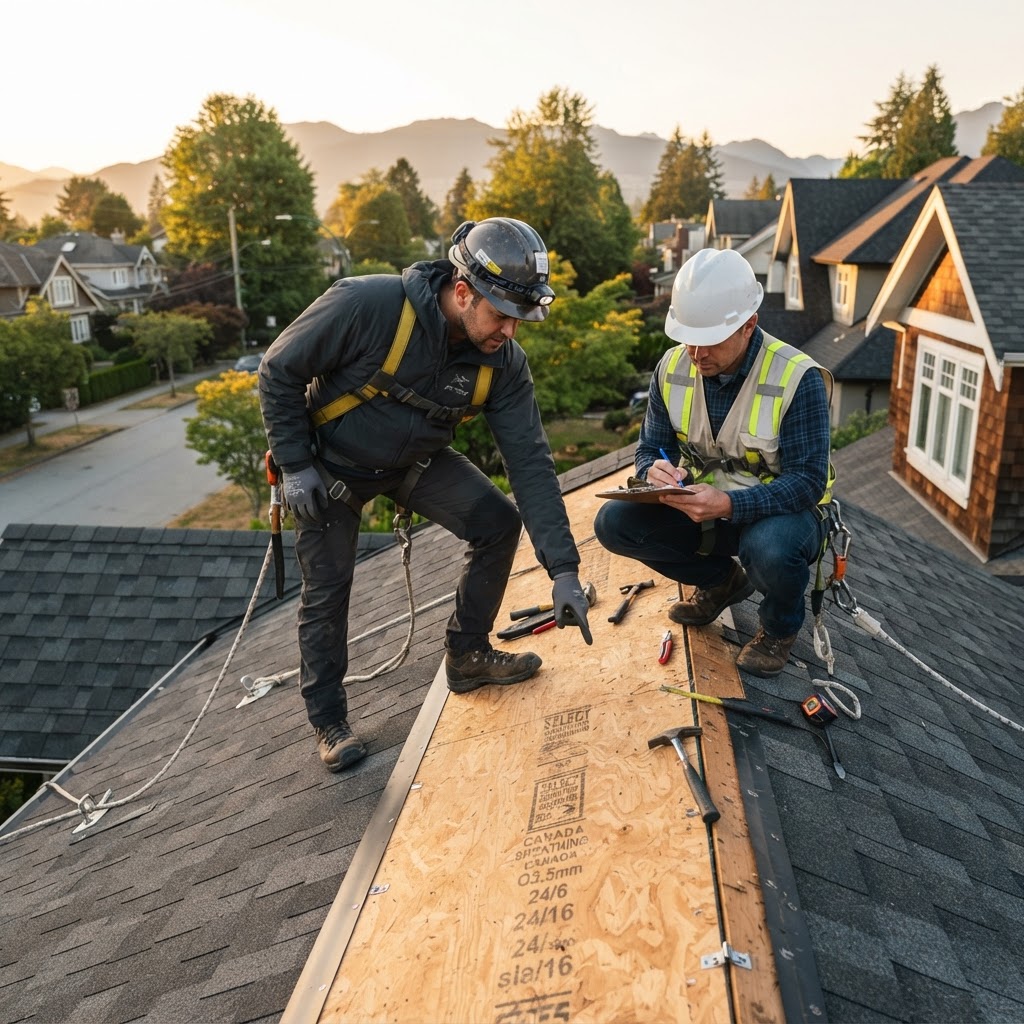
Roof deck integrity is another area where the code is specific and strict. According to the RCABC Roofing Practices Manual section on Roof Decks, the deck must limit deflections to no more than 1/240 of the total span, and for low-slope membrane roofs, a minimum plywood thickness of 12.7 mm (1/2 inch) is required. We've shown up to Coquitlam roof repair jobs where previous contractors had laid new shingles directly over a deck that was soft, delaminated, or thinner than code allows. This creates a situation where the new roof membrane has no solid substrate to bond to, dramatically shortening its effective lifespan. When we do a full inspection, we probe the deck from the attic side and look for discolouration, sagging between rafters, and any areas where the plywood has lost its structural integrity. Replacing compromised decking adds to the upfront cost, but skipping it puts the entire reroof investment at risk.
WorkSafeBC also plays a significant role in how professional roofing crews operate on your property. Fall protection requirements are strictly enforced for any roofing work performed above a certain height, which means legitimate contractors will always show up with proper harness systems, anchor points, and edge protection equipment. If you ever get a quote from a roofer who doesn't mention safety gear, that's a red flag. Not only does it expose their workers to serious injury risk, but it also exposes you as the homeowner to potential liability if someone is hurt on your property. For a more detailed look at what separates professional contractors from cut-rate operators, our guide on Coquitlam Roofing Contractor: 9 Proven Tips for Your Roof covers the vetting process thoroughly.
Choosing the Right Materials for Reroofing in Coquitlam
Choosing the right roofing material for a Coquitlam home is not as straightforward as picking something from a brochure. Our climate is fundamentally different from drier interior regions like the Okanagan, and materials that perform brilliantly in Kelowna may deteriorate quickly here if they're not specified and installed correctly for a temperate rainforest environment. The RCABC Consumer Guide to Roofing is an excellent resource that explains the performance expectations and installation standards for the most common residential roofing systems used in BC. We always walk our clients through this kind of information before any Coquitlam roof repair or full reroof project begins, because an informed homeowner makes better decisions and ends up with a roof that truly suits their home and budget.
Asphalt shingles remain the most popular choice for Coquitlam homes, and for good reason. Modern architectural (laminate) shingles carry manufacturer warranties ranging from 25 to 50 years, and when installed to RCABC standards with the correct underlayment and ice-and-water shield at the eaves, they perform reliably in our wet climate. We recommend a minimum 2-ply SBS-modified bitumen underlayment beneath asphalt shingles on any roof with a pitch below 4:12, as standard felt can saturate and wrinkle in our high-moisture conditions. Shingle weight matters too - heavier laminate products in the 200-240 gram-per-square-metre range tend to resist wind uplift and UV degradation better than entry-level options. For a detailed breakdown of what a full replacement involves and what drives the cost, our post on Roof Replacement Cost Vancouver: 10 Proven Insights is a solid starting point.
Cedar roofing is a beautiful and distinctly West Coast option, but it demands a level of maintenance that many homeowners underestimate. In our experience installing and restoring cedar shake and shingle roofs across Coquitlam, the damp Lower Mainland climate accelerates moss and lichen colonisation compared to drier BC regions. Without regular treatment and cleaning, moss holds moisture against the wood fibres and causes premature splitting and cupping. The RCABC guide on roofing services in BC specifically notes that cedar roofing in the Lower Mainland requires climate-specific maintenance protocols. A well-maintained cedar roof can last 30 to 40 years, but neglected cedar often fails within 15 to 20 years in our climate. We typically recommend a biannual moss treatment and a professional inspection every three to four years for cedar roofs to stay ahead of any developing issues.
Concrete and clay tile roofing is less common in Coquitlam but does appear on certain architectural styles, particularly in newer developments near Westwood Plateau. Tile is extremely durable and fire-resistant, but it's also heavy - structural assessments are often required before a tile reroof to confirm the existing framing can carry the additional load. Tile is also more vulnerable to moss colonisation than asphalt in our wet conditions, and individual cracked tiles need prompt replacement to prevent water from tracking under the system. Whatever material you're considering, the best first step is always a thorough professional inspection to understand the current condition of your deck, flashing, and drainage system before committing to a material. Reach out to us for a free quote and we'll help you weigh the options honestly based on your home's specific situation and your long-term goals. You can also explore Coquitlam Roofing Services: 9 Proven Maintenance Steps for a broader look at how ongoing care extends the life of any roofing system you choose.
- Asphalt architectural shingles: 25 to 50-year warranties, low maintenance, best value for most Coquitlam homes
- Cedar shakes and shingles: 30 to 40-year lifespan with proper maintenance, requires biannual moss treatment in our climate
- Concrete and clay tile: extremely durable and fire-resistant, but requires structural assessment due to weight
- SBS-modified bitumen membrane: ideal for low-slope sections, highly flexible in cold and wet conditions
- All materials must meet RCABC installation standards and BC Building Code requirements for your specific roof geometry and wind exposure zone
The Importance of Professional Roof Inspection
Annual roof inspections are one of the smartest investments a Coquitlam homeowner can make, and we've seen firsthand how a single overlooked crack or worn flashing can turn into a costly repair after the first heavy rainfall. Coquitlam sits in a temperate rainforest climate where annual precipitation regularly exceeds 1,500 mm, meaning your roof endures relentless moisture month after month. Hidden damage - cracked shingles, lifted membrane edges, blocked drainage points - rarely announces itself until water has already found its way indoors. A certified roofing professional can identify these vulnerabilities before winter storms arrive and before your repair bill multiplies. That's why we recommend scheduling an inspection every autumn without fail.
Most Vancouver homeowners we work with are surprised by what a thorough inspection actually covers. It's not just a quick visual scan from the ground. A qualified inspector will check your roof deck for signs of deflection, verify that structural loading meets the requirements outlined in BC Building Code Division B, Part 4, and assess whether flashings, valleys, and penetrations are properly sealed against Coquitlam's persistent rain. They'll also look at the condition of your underlayment, check for signs of moss colonisation along the north-facing slopes, and evaluate the performance of your ventilation system. This level of detail simply isn't possible without climbing on the roof and knowing exactly what to look for.
In our experience installing and repairing roofs across Coquitlam and the Tri-Cities, the homes that avoid major structural damage are almost always the ones with a consistent inspection history. We've seen cedar shake roofs that looked perfectly fine from the street but had significant rot along the eaves because the owner hadn't had anyone up there in five years. We've also seen asphalt shingle roofs where minor granule loss had gone unnoticed until the underlayment was fully exposed to moisture. Early detection is the difference between a Coquitlam roof repair that costs a few hundred dollars and a full reroof that runs into the thousands. Booking an annual inspection is the single most effective preventive measure you can take as a homeowner. For more on what a professional inspection involves, our Coquitlam Roofing Services: 9 Proven Maintenance Steps post covers the process in detail.
Certified professionals also ensure your roof meets current industry standards set by the Roofing Contractors Association of BC (RCABC). The RCABC's Consumer Guide to Roofing outlines exactly what homeowners should expect from a qualified contractor, including proof of licensing, insurance, and adherence to the Roofing Practices Manual. These aren't just bureaucratic formalities - they're protections for you and your home. A roof that doesn't meet BC Building Code requirements can create issues with your home insurance, complicate future property sales, and leave you exposed to liability. Always ask to see your contractor's RCABC membership credentials before any work begins.
Roof Maintenance Best Practices for Coquitlam Homes
Routine roof maintenance is the backbone of any long-term Coquitlam roof repair strategy, and the good news is that most of it is straightforward when you stay on top of it. The RCABC Roofing Practices Manual provides detailed guidance on maintenance protocols for the Lower Mainland's unique climate, and we follow those guidelines on every job we do. Moss and algae growth are the most common maintenance issues we encounter in Coquitlam - the combination of shade, moisture, and mild temperatures creates ideal conditions for biological growth on both asphalt and cedar roofs. Left untreated, moss rhizoids penetrate shingle surfaces and lift edges, allowing water to track underneath and saturate the roof deck. A proactive treatment schedule keeps this in check without causing the shingle damage that can come from aggressive pressure washing.

Cedar roofing in the Lower Mainland requires particularly attentive maintenance compared to drier regions like the BC Interior. The persistent dampness in Coquitlam means cedar shakes and shingles absorb moisture at a much higher rate, which accelerates splitting, cupping, and rot if the wood isn't cleaned and treated regularly. According to the RCABC's guide for the selection of Roofing Services, cedar restoration in the Lower Mainland involves careful cleaning, biocide application, and where necessary, the replacement of individual shakes that have deteriorated beyond an acceptable threshold. We've completed cedar restoration on dozens of Coquitlam homes and the results are consistently impressive - a well-maintained cedar roof can extend its service life by 10 to 15 years beyond what a neglected roof would last. If you have cedar, treat it like the natural material it is and give it the care it deserves.
Gutter cleaning is another maintenance task that directly impacts your roof's health, and it's one that many homeowners put off far too long. Blocked gutters cause water to back up under your drip edge, saturating the fascia board, the roof deck edge, and eventually the interior wall cavity. In Coquitlam's rainy seasons, a gutter blocked with leaf debris from the area's many mature trees can overflow during a single storm event and cause significant damage in a matter of hours. We recommend cleaning gutters at least twice a year - once in late spring after the seed drop and once in late autumn after the leaves have fallen. For a detailed breakdown of why this matters so much, read our guide on Gutter Cleaning Vancouver: 7 Essential Tips for Home Protection.
Roof maintenance also means keeping an eye on the condition of your roof deck, particularly after major wind events or heavy snowfall. The RCABC Roofing Practices Manual on Roof Decks specifies that deflection must be limited to 1/240 of the total span, and that low-slope membrane roofs require a minimum plywood thickness of 12.7 mm (1/2 inch). If your deck is showing signs of sagging or soft spots underfoot, that's a red flag that needs professional attention immediately. We've seen decks that were pushed well beyond their design limits simply because water had been infiltrating undetected for a season or two. Following a maintenance schedule that covers all these elements - moss treatment, gutter cleaning, flashing inspection, and deck assessment - will dramatically reduce your risk of a serious Coquitlam roof repair situation down the road. Our Coquitlam Roofing Contractor: 9 Proven Tips for Your Roof post outlines additional maintenance steps worth adding to your annual routine.
Why Hire a Professional Roofing Contractor for Coquitlam Roof Repair
Hiring a professional roofing contractor for your Coquitlam roof repair isn't just about getting the job done properly - it's about safety, compliance, and protecting your home's value for the long term. WorkSafeBC strictly regulates roofing work in British Columbia, requiring that all contractors implement fall protection systems, maintain up-to-date safety plans, and ensure workers are trained to WorkSafeBC standards before setting foot on any roof. These regulations exist for very good reason - roofing consistently ranks among the highest-risk trades in the province. When you hire a qualified contractor, you're not just paying for materials and labour; you're paying for a team that knows how to do the job safely, correctly, and in compliance with every applicable regulation.
Professional roofers also bring technical knowledge that a DIY approach simply can't replicate. Understanding how to calculate wind loads per BC Building Code Division B, Part 4, selecting the right membrane system for a low-slope application, or properly integrating step flashings at a dormer intersection - these are skills that come from years of hands-on training and field experience. In our experience installing roofs across Coquitlam and the broader Tri-Cities area, the repairs that fail within a year or two are almost always ones where the original work was done by an unqualified contractor or a well-meaning homeowner who didn't have the technical background to do it correctly. A proper repair done right the first time is always more cost-effective than redoing it twelve months later. For context on what professional roofers offer across the region, see our Roofing Company in Coquitlam: 5 Proven Services post.
Choosing the right contractor also means choosing one who stands behind their work with a written warranty and appropriate liability insurance. A reputable Coquitlam roof repair company will provide you with a detailed written quote, explain the scope of work clearly, and offer a workmanship warranty that covers the repair for a defined period. Materials warranties from manufacturers like GAF, IKO, or BP are only valid when the product is installed by a certified contractor following the manufacturer's specifications - another reason why cutting corners on your choice of roofer can cost you dearly down the line. We encourage every homeowner to ask for proof of insurance, WCB clearance, and RCABC membership before signing any contract. These aren't unreasonable requests - they're standard practice among professional roofing contractors in BC.
At Red Maple Roofing, we've built our reputation on transparent communication, quality workmanship, and genuine care for the homes we work on across Coquitlam and the Greater Vancouver area. We follow all RCABC guidelines, comply fully with WorkSafeBC safety standards, and treat every Coquitlam roof repair project - large or small - with the same level of professionalism. Whether you're dealing with a minor flashing repair, persistent moss problems, or a roof that's approaching the end of its service life, we're here to give you honest advice and a fair, detailed quote. Browse our services to get a sense of the full range of work we cover, or visit our service areas page to confirm we work in your neighbourhood. We're always happy to answer questions before you commit to anything.
How often should I schedule a roof inspection in Coquitlam?
What is the best moss treatment for cedar roofs in BC?
How do I know if I need a simple roof repair or complete reroofing?
Why is gutter cleaning important for roof maintenance?
Does the BC Building Code require specific plywood thickness for roof decks?
Protecting your home starts with protecting your roof, and for Coquitlam homeowners that means staying proactive about inspections, maintenance, and choosing the right professional for every Coquitlam roof repair job. Whether you're noticing early signs of moss, dealing with a slow leak, or simply overdue for an annual check-up, Red Maple Roofing is ready to help. Call us today at (778) 239-1701 or visit our free quote page to get started. We serve Coquitlam and the surrounding communities with honest advice, quality workmanship, and the kind of friendly service that keeps our neighbours calling us back year after year.