Get a No-Obligation Quote
We respond within 2 hours during business hours.

By the Red Maple Roofing team in Coquitlam. Reviewed for accuracy by Rasheed, Founder & Lead Estimator, Red Maple Roofing.
Finding the right roofing company in Surrey can feel overwhelming, especially when you're dealing with a leaking roof in the middle of a Lower Mainland downpour. At Red Maple Roofing, we've worked with hundreds of Surrey homeowners over the years, and we know firsthand how the local climate puts roofs through their paces year after year. Surrey sits right in the heart of the Greater Vancouver region, where annual rainfall regularly exceeds 1,500 mm, humidity stays high for much of the year, and seasonal wind storms roll in off the Pacific with little warning. Your roof isn't just a cosmetic feature - it's your home's primary defence against all of that, and choosing the right contractor makes all the difference.
We've seen firsthand what happens when a Surrey home's roof is installed without proper attention to BC Building Code requirements or local weather realities. Shingles lift, flashings fail, and what starts as a small drip turns into a costly structural repair. That's why we put together this guide - to walk you through what to look for in a roofing company in Surrey, what the code actually requires, which materials hold up best in our wet climate, and why regular maintenance is the smartest investment you can make as a homeowner. Whether you're planning a full reroof or just need a professional inspection before the rains hit, we're here to help you make informed decisions. Our Surrey roofing services page covers local jobs, permits and neighbourhoods we serve in Surrey.
Why Choose a Local Roofing Company in Surrey?
Hiring a local roofing company in Surrey means you're working with contractors who genuinely understand the conditions your roof faces every single season. This isn't a small thing. The Lower Mainland gets a very different kind of weather than, say, Calgary or Toronto - we're talking sustained wet seasons, not just occasional heavy rain. Contractors who work exclusively in the Greater Vancouver area have calibrated their material choices, installation methods, and inspection checklists specifically around these conditions. A roofer who primarily works in a drier climate may not think twice about attic venting, but in Surrey, improper venting leads to trapped moisture, mould growth, and premature decking failure. We've walked into attics in Surrey homes where previous contractors simply didn't account for this, and the damage was significant.
Local knowledge extends beyond just knowing it rains a lot. A Surrey-based roofing company will be familiar with the specific neighbourhoods, common roof designs in the area, and even the micro-climates that exist across different parts of the city. The Cloverdale area, for instance, sees slightly different wind patterns compared to the Fleetwood or South Surrey neighbourhoods closer to the estuary. Most Vancouver homeowners we work with are surprised to learn just how location-specific roofing recommendations can be. Choosing a contractor who knows Surrey means getting advice tailored to your specific street, not just generic guidance pulled from a manufacturer's brochure. That level of local expertise is something you simply can't replicate by hiring a contractor from outside the region.
Local roofing companies in Surrey also have established relationships with local suppliers, which means faster turnaround on materials and better access to products that are suited to BC's climate. When a storm causes widespread damage across the Lower Mainland, a well-connected local contractor can source replacement shingles or flashings far more quickly than a company flying in crews from out of province. We've seen post-storm scenarios where homeowners waited weeks for out-of-area contractors to source materials, while our local supplier relationships had us back on the roof within days. Beyond speed, local contractors are also more accountable - they have a reputation to maintain in the community where they live and work, which keeps standards high. If you're curious about the range of work we handle across the region, take a look at our service areas page for a full breakdown.
There's also the matter of ongoing support. A local roofing company in Surrey isn't going to disappear after the job is done. If a flashing shifts six months later or a warranty question comes up, you can actually reach someone who knows your roof and can come back to take a look. We've had clients call us two or three years after a reroof simply because they noticed a small change during a heavy rain event. That kind of long-term relationship is only possible when you're working with a team rooted in the local community. It's the difference between a transaction and a genuine partnership in protecting your home. You can also check out our guide on How to Choose a Roofing Contractor in Vancouver for more perspective on what to expect from a professional roofing relationship.
In our experience, the most expensive roofing problems we fix in Surrey aren't caused by bad materials - they're caused by contractors who didn't understand local climate demands. Proper attic venting, correct pitch compliance, and weather-specific flashing details are what separate a roof that lasts 25 years from one that needs attention in five. Local knowledge isn't a bonus; it's the foundation of every good roofing job in the Lower Mainland.
Understanding BC Building Code Requirements for Roofs
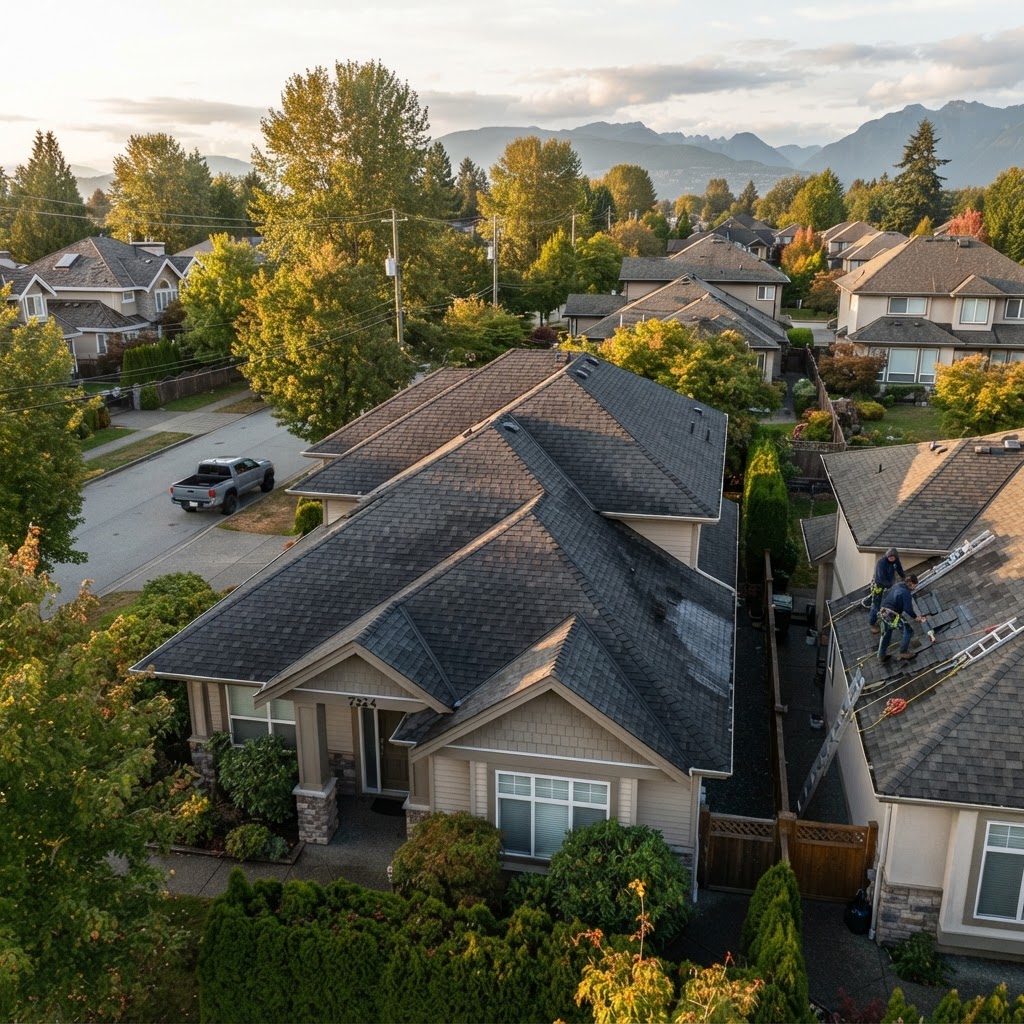
The BC Building Code sets out clear minimum standards for residential roofing, and compliance isn't optional - it's the baseline for a safe, durable roof in our climate. Division B, Part 4, Section 4.1.7 of the Code covers structural and wind load calculations that every roofing contractor working in Surrey needs to understand and apply. Wind uplift is a real concern in the Lower Mainland, where Pacific storms can generate sustained gusts that put enormous lateral and vertical stress on a roof assembly. The National Research Council of Canada even provides a Wind Load Calculator for Roof Assemblies that professionals use to verify that a given roof design can handle local wind pressures. In our experience installing reroofs across Surrey and the Greater Vancouver area, running these calculations before specifying fastener schedules and underlayment details is a standard part of our process, not an afterthought.
One of the most frequently misunderstood BC Building Code requirements is the 1:300 attic venting rule. This requirement mandates that for every 300 square metres of attic floor area, at least 1 square metre of free ventilation area must be provided. In practical terms for a typical Surrey home, this translates to a carefully balanced system of soffit intake vents and ridge or high-wall exhaust vents that allow continuous airflow through the attic space. Without proper venting, moisture-laden air from the living areas below migrates into the attic, condenses on the underside of the roof deck, and begins a slow process of degradation that can compromise the structural integrity of the entire roof assembly. We've pulled back insulation on inspection calls to find deck boards that were visibly rotting - not because the shingles failed, but because the venting was undersized or blocked by improper insulation installation.
The Code also specifies a standard minimum pitch of 4:12 for asphalt shingle installations on residential reroofing projects in BC. A 4:12 pitch means the roof rises 4 inches vertically for every 12 inches of horizontal run, which is steep enough to shed water effectively while remaining practical for most Surrey home designs. Lower pitches can be accommodated, but they require specific low-slope roofing systems - typically a torchdown or modified bitumen membrane - rather than standard three-tab or architectural shingles. Most Vancouver homeowners we work with don't realise that installing shingles on a sub-code pitch voids both the manufacturer's warranty and any workmanship guarantee the contractor provides. Getting pitch-compliant from the start protects your investment for the full expected lifespan of the roof material. For a broader look at what code compliance means for your budget, our Roof Replacement Cost in Vancouver post covers this in useful detail.
Beyond pitch and venting, the Code has specific requirements around underlayment, ice and water shield application at eaves, and the fastening schedules for different shingle types in different wind zones. Surrey falls within a wind zone that requires particular attention to fastening - a standard six-nail pattern per shingle rather than the four-nail minimum sometimes used in lower-exposure regions. The RCABC Roofing Practices Manual aligns closely with these Code requirements and provides the detailed installation guidance that qualified contractors follow on every job. Reputable contractors working in Surrey will be able to walk you through these specifications clearly and show you how their installation methods meet or exceed the minimum standards. If a contractor can't explain their fastening schedule or venting plan, that's a serious red flag worth taking seriously before you sign anything.
Asphalt, Cedar, and Tile: Best Materials for Surrey Weather
Choosing the right roofing material for a Surrey home isn't simply about aesthetics - with annual rainfall that can exceed 1,500 mm, the material you choose has a direct impact on how long your roof lasts and how much maintenance it requires over its lifetime. Across Surrey and the broader Lower Mainland, three materials dominate residential roofs: architectural asphalt shingles, cedar shakes, and concrete or clay tiles. We install architectural asphalt and convert cedar to asphalt; we do not install tile. Each has a different performance profile in our wet, windy climate, and each has specific installation requirements under the RCABC Roofing Practices Manual that must be followed to maintain both warranty coverage and code compliance. Understanding these differences upfront helps you have a more productive conversation with any roofing company in Surrey you're considering for your project.
Architectural asphalt shingles are by far the most commonly specified product for Surrey reroofing projects, and for good reason. Modern architectural shingles are laminated, meaning they consist of two or more layers of fibreglass-reinforced asphalt fused together, which gives them a dimensional profile and significantly better wind resistance than the older three-tab style shingles many Surrey homes still have. Quality architectural shingles carry wind ratings of 130 km/h or higher, and when installed with a six-nail fastening pattern on a properly prepared deck with a full ice and water shield at the eaves, they perform reliably through decades of Lower Mainland winters. Most products in this category carry 30-year or lifetime limited warranties, though actual performance life in our climate typically runs 20 to 25 years depending on roof orientation, tree coverage, and maintenance history. For homeowners looking to understand the full cost picture, we recommend reviewing our services page or reaching out for a free quote.
Cedar shakes and shingles have a long history on Lower Mainland homes, and they remain a premium choice for homeowners who value the natural appearance and insulating properties of real wood. Western red cedar is naturally resistant to moisture and decay, and a properly installed cedar roof can last 30 to 40 years in our climate with consistent maintenance. The critical qualifier there is maintenance - cedar requires regular cleaning to prevent moss and lichen growth, periodic retreatment with a preservative or fire retardant, and prompt replacement of any cracked or cupped shakes before water infiltration begins. We've inspected cedar roofs in Surrey that were 35 years old and still in excellent condition because the owners were diligent about biennial maintenance, and we've also seen cedar roofs barely 15 years old that were failing due to total neglect. If you're considering cedar, build the ongoing maintenance cost into your long-term budget from day one, and check out our guide on Roof Moss Removal & Treatment for an idea of what that care involves.
Concrete and clay tiles are less common on Surrey residential roofs but are gaining traction, particularly in newer developments in South Surrey and Morgan Heights where Mediterranean-influenced architectural styles are popular. Tile is extremely durable - properly installed concrete tiles can last 50 years or more - and it's inherently resistant to moisture, fire, and insect damage. The primary considerations are structural: tile is significantly heavier than asphalt or cedar, and older Surrey homes may require an engineering assessment to confirm the roof framing can support the added load before a tile reroof is approved. Installation also demands a higher level of technical skill, particularly around valleys, hips, and penetrations where the rigid tile geometry creates complex waterproofing challenges. A qualified roofing company in Surrey with tile experience will handle these details correctly; an inexperienced crew rushing through a tile job is where most of the costly failures originate.

The Importance of Regular Roof Maintenance and Repair
Regular roof maintenance is genuinely the most cost-effective roofing decision a Surrey homeowner can make, and we say that not as a sales pitch but as a reflection of what we see on job sites every single season. A minor repair caught during an annual inspection - a cracked flashing seal, a handful of lifted shingles, a blocked soffit vent - typically costs a fraction of what the same issue becomes if left unaddressed through one or two full wet seasons. Surrey's rainfall pattern is particularly unforgiving in this regard because the volume of water that passes over and around a roof each year means that even small vulnerabilities get tested repeatedly and relentlessly. We've arrived on emergency repair calls in January where the original defect was clearly visible and could have been fixed the previous September for a few hundred dollars, but had by then turned into a saturated deck section requiring partial replacement.
Annual inspections are the cornerstone of any good maintenance programme, and we recommend scheduling them in late summer or early autumn - after the drier months have allowed any existing issues to stabilise and before the first sustained rains of the season arrive. A thorough inspection by a qualified roofing company in Surrey should cover the condition of all shingles or shakes, the integrity of all flashings at chimneys, skylights, walls, and valleys, the state of the ridge cap, the condition and clearance of all gutters and downspouts, and a visual assessment of the attic space for signs of moisture or inadequate venting. For a detailed breakdown of what a professional maintenance visit covers, our Coquitlam Roof Maintenance Guide post is a useful reference, as the same standards apply across the Greater Vancouver region including Surrey.
Moss and algae growth is a maintenance issue that's particularly prevalent on Surrey roofs, especially on north-facing slopes and sections shaded by mature trees. Moss retains moisture against the surface of the shingles or shakes, accelerating granule loss on asphalt products and accelerating decay on cedar. Left unchecked, a heavy moss colony can also cause physical damage by lifting shingle tabs at their edges, creating entry points for wind-driven rain. The good news is that moss is very manageable with the right treatment applied at the right time - typically a zinc- or copper-based treatment applied in autumn that kills moss progressively over the following season without damaging the roofing material. We've seen homes in Surrey where biennial moss treatment has extended the life of an asphalt shingle roof by five or more years compared to similar roofs left untreated. You can learn more about what this involves in our Roof Moss Removal & Treatment guide.
Gutter maintenance is inseparable from roof health, and it's an area where many Surrey homeowners inadvertently create roof problems by neglecting what seems like a minor chore. Gutters clogged with leaf debris, evergreen needles, or moss overflow during heavy rain events, and that overflow doesn't just flow harmlessly to the ground - it backs up under the eave, saturates the fascia board, and can wick moisture back up under the first course of shingles at the roof edge. In our experience, homes surrounded by Douglas fir or cedar trees need their gutters cleared at least twice a year, in late autumn after leaf fall and again in early spring. Pairing gutter cleaning with your annual roof inspection is the most efficient approach and ensures nothing gets missed. Our Gutter Cleaning & Maintenance post covers the full process, and we'd encourage any Surrey homeowner to read it before the next rain season begins. If you'd like a professional to take care of both in a single visit, get in touch for a free quote and we'll put together a maintenance plan that fits your home and budget.
Gutter Cleaning and Repair for Heavy Rainfall
Surrey sits in one of the wettest regions in Canada, and your gutters are the first line of defence against that relentless rainfall. The Greater Vancouver area receives well over 1,500 mm of rain annually, and when gutters are clogged, cracked, or pulling away from the fascia, all that water has nowhere to go except back under your roof deck. We've seen firsthand how a single blocked downspout can lead to rotting fascia boards, saturated roof decking, and even mould growth inside the attic within just one season. It's a surprisingly fast chain reaction, and it's entirely preventable with routine gutter maintenance from a qualified roofing company in Surrey.
In our experience servicing Surrey homes, the most common gutter problems we find are compacted leaf debris near downspout openings, sagging gutter sections caused by failed hangers, and hairline cracks along the seams that worsen over winter. Most Vancouver homeowners we work with don't realise that even a small sag of just 5 to 10 mm along a 3-metre gutter run is enough to cause water pooling. Standing water in gutters accelerates corrosion in aluminium and vinyl systems, and in colder snaps it freezes and expands, splitting seams wide open. A proper gutter inspection includes checking the slope, resealing all seams with a compatible sealant, and testing downspout flow with a running hose. For more detail on what a thorough gutter service involves, our post on Gutter Cleaning & Maintenance walks you through the full process.
Gutter repairs that get overlooked tend to become gutter replacements within a few years. That's a more expensive outcome that's almost always avoidable. When our crews assess gutters, we look at five key indicators: the condition of the fascia behind the gutter, the integrity of all seam joints, the spacing and security of gutter hangers, the diameter and alignment of downspouts, and the placement of downspout extensions away from the foundation. Surrey's clay-heavy soils don't drain quickly, so water directed too close to the foundation can cause hydrostatic pressure issues in basements and crawl spaces. Pairing a properly functioning gutter system with a well-maintained roof is truly the most cost-effective approach to protecting your home. If you want a comprehensive look at all the services that support a healthy roof, take a look at our services page.
We recommend Surrey homeowners schedule a professional gutter clean at minimum twice a year: once in late October after the leaf fall, and again in early March after the heavy winter rain season. Homes surrounded by Douglas fir, cedar, or big-leaf maple trees may need a third clean in late summer when seed pods and organic debris accumulate quickly. During each visit, our team doesn't just clear debris - we document the condition of every gutter section, note any areas of concern, and provide a written summary so you have a record for insurance or future reference. Good documentation can make a real difference if you ever need to file a claim after a storm event. A proactive roofing company in Surrey will always combine gutter service with a visual roof check at the same visit.
Effective Moss Treatment for BC Climates
If you've driven through Surrey's older neighbourhoods, you've almost certainly seen roofs with a thick green carpet of moss running along the north-facing slopes. That's not just an aesthetic issue. Moss holds moisture against your roofing material, and in a climate where humidity is consistently high, that trapped moisture breaks down asphalt shingle granules, degrades cedar fibres, and compromises the bond of your underlayment over time. We've seen perfectly sound 15-year-old roofs that needed full replacement years ahead of schedule simply because moss was left untreated. A reliable roofing company in Surrey will always include moss assessment as a standard part of any roof service visit.
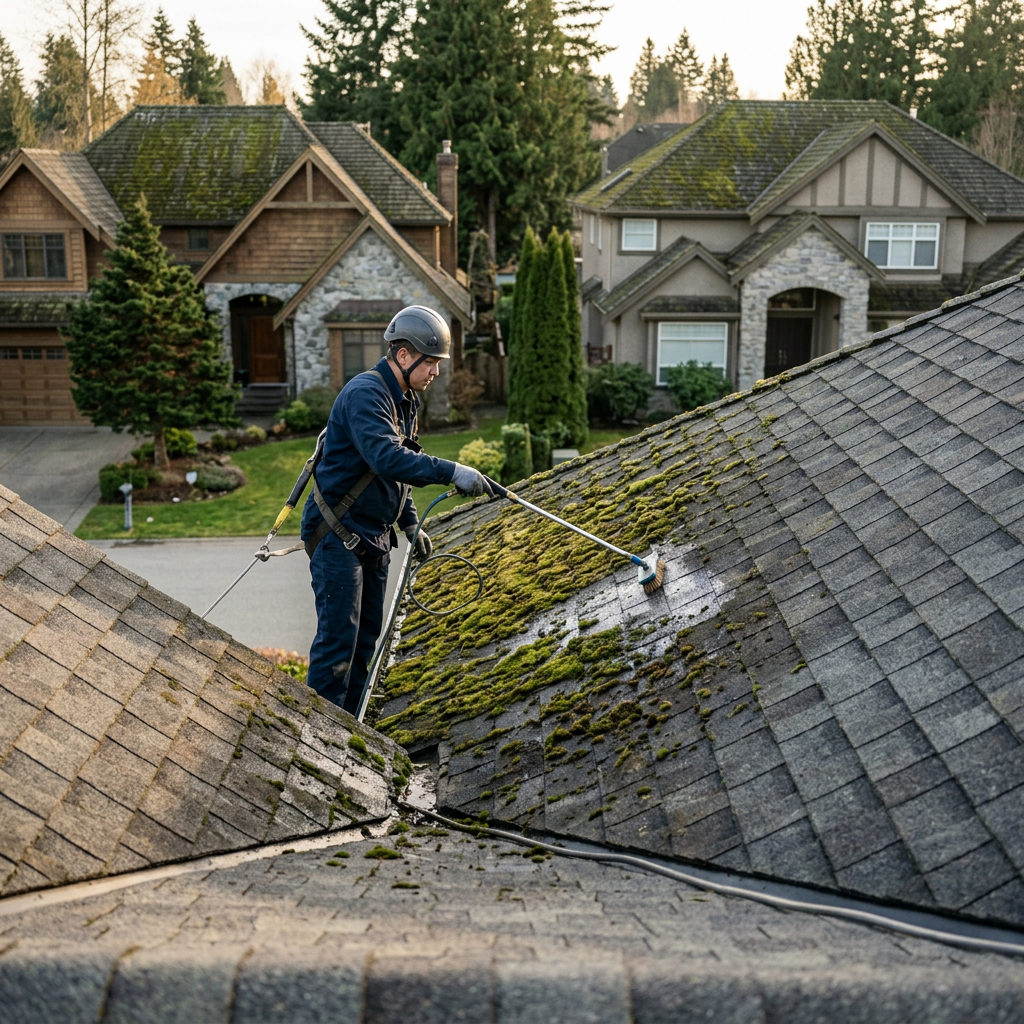
Professional moss treatment is a very different process from simply power-washing a roof. In fact, high-pressure washing is something we strongly advise against - it strips granules from asphalt shingles and can force water under laps, causing far more damage than the moss itself. The correct approach involves a soft-wash application of a biocide solution approved for use on roofing materials, followed by a careful low-pressure rinse once the moss has been killed and loosened. The RCABC Roofing Practices Manual sets clear standards for accepted maintenance techniques, and any reputable roofing company in Surrey should be following those guidelines when performing moss treatment. Our team uses treatments compatible with both asphalt shingle and cedar shake systems, because the chemistry involved is quite different between the two material types.
After the treatment itself, there are preventive steps that make a real long-term difference. Zinc or copper strip installation along the ridge is one of the most effective long-term moss deterrents available. When it rains, trace amounts of metal ions wash down the slope and create an environment that's inhospitable to moss, algae, and lichen. We've seen zinc strips reduce moss regrowth by a significant margin on Surrey homes over a three to five year observation period. Trimming overhanging branches to allow more sunlight onto the roof surface also helps considerably, since moss thrives in shaded, damp conditions. For a deeper look at what professional moss removal involves and what homeowners can expect, our post on Roof Moss Removal & Treatment covers the topic thoroughly.
Cedar roofs require particular attention when it comes to moss management in Surrey's climate. Cedar is a natural material that's naturally resistant to moisture to a degree, but that resistance diminishes when moss and debris accumulate and keep the surface perpetually damp. A well-maintained cedar roof can last 25 to 30 years in the Lower Mainland, but a neglected one with chronic moss growth may need replacement in 15 years or fewer. The treatment schedule for cedar is generally more frequent - we typically recommend a professional assessment every two years for cedar shake roofs, compared to every three to four years for asphalt shingles in a comparable location. If you're unsure where your roof sits on that spectrum, a professional inspection is the best starting point. You can get a free quote and we'll assess the current condition of your roof at the same time.
- Visual assessment of moss coverage, density, and roof material condition
- Soft-wash application of a biocide solution rated for roofing substrates
- Low-pressure rinse once organic growth has been neutralised
- Debris clearance from valleys, ridges, and gutters
- Optional zinc or copper strip installation along the ridge for long-term prevention
- Written report documenting treatment areas and any underlying shingle damage observed
What to Expect During a Professional Roof Inspection in Surrey
A professional roof inspection is one of the most valuable services a roofing company in Surrey can provide, yet it's also one of the most underused. Many homeowners assume that if there's no active leak, the roof is fine. In our experience, that's rarely the whole picture. Roofs can be losing granules at an accelerating rate, developing micro-cracks in the underlayment, or showing early signs of wind uplift damage well before a leak ever appears inside the home. Catching these issues early means the repair scope is smaller, the cost is lower, and the lifespan of your existing roof is extended. We always recommend a formal inspection after any significant wind event or hailstorm, and at minimum every two to three years for roofs under 15 years old.
During a comprehensive inspection, our team evaluates several interconnected systems rather than just the visible shingle surface. We assess the condition of the shingles themselves - looking for granule loss, cracking, curling, and any areas of impact damage. We examine the underlayment at any accessible penetration points, including around pipe flashings, roof vents, and chimney bases, since these are statistically the most common locations for early water ingress in Surrey homes. We also check attic ventilation, because the BC Building Code requires a 1:300 venting ratio - meaning one square metre of ventilation for every 300 square metres of attic floor area - and under-ventilated attics create moisture problems that degrade the roof structure from the inside out. The RCABC VRA Standard provides the technical benchmarks our inspectors use to evaluate roof assembly performance against BC climate conditions.
Wind uplift assessment is another element of a thorough inspection that often gets missed by less experienced contractors. Surrey and the broader Metro Vancouver area experience seasonal wind storms that generate significant uplift pressure, particularly on gable ends and ridge lines. The BC Building Code specifies structural and wind load calculations under Division B, Part 4, Section 4.1.7 to ensure roof assemblies can handle these forces. During inspection, we look for lifted shingle tabs, nail pull-through, and any areas where the bond between shingles has failed, since these are clear indicators that wind resistance has been compromised. Identifying these spots early and re-securing affected shingles is a straightforward repair - leaving them means a moderate windstorm can strip a large section of your roof in minutes. Our post on 24/7 Emergency Roof Repair covers what to do if wind damage occurs between scheduled inspections.
At the end of an inspection, a trustworthy roofing company in Surrey will give you a written report with photographs, a clear explanation of any deficiencies found, and honest guidance on whether repairs, maintenance, or full reroofing is the appropriate next step. We don't believe in pressuring homeowners into unnecessary work - if your roof has five good years left and just needs some flashing resealed, that's exactly what we'll tell you. Transparency is how we build long-term relationships with Surrey homeowners. If you've never had a formal inspection done, or if it's been more than three years since the last one, now is a good time to book one before the heavy autumn rain season arrives. You can also read about Roof Replacement Cost in Vancouver to better understand the financial picture if your inspection does indicate that a full reroof is on the horizon. Reach out through our free quote page and we'll get an inspection scheduled at your convenience.
- Shingle condition: granule loss, cracking, curling, and impact damage
- Flashing integrity at all penetrations, valleys, and roof-to-wall junctions
- Underlayment assessment at accessible points around vents and pipes
- Attic ventilation ratio check against the BC Building Code 1:300 requirement
- Wind uplift evaluation: lifted tabs, nail pull-through, and failed adhesive bonds
- Gutter and downspout condition relative to roof drainage
- Written report with photographs and prioritised recommendations
Navigating the RCABC RoofStar Guarantee
One of the most reassuring things a homeowner in Surrey can hear from a roofing company in Surrey is that their project qualifies for the RCABC RoofStar Guarantee. This guarantee isn't just a piece of paper - it's a meaningful commitment backed by the Roofing Contractors Association of BC, one of the most respected industry bodies in the country. To qualify, every material used and every installation technique applied must meet the rigorous standards laid out in the Roofing Practices Manual (RPM). In our experience installing roofs across the Lower Mainland, homeowners who understand this guarantee feel far more confident in their investment from day one.
The RPM sets the accepted standards for materials and installation practices across British Columbia, and it's updated regularly to reflect advances in roofing science and changes to the BC Building Code. We've seen firsthand what happens when a roof is installed by a contractor who isn't following the RPM - premature shingle lifting, chronic moisture intrusion, and voided manufacturer warranties are just a few of the consequences. The RoofStar Guarantee specifically covers both materials and workmanship, which is a dual layer of protection most homeowners don't realise they can have. If you're comparing quotes from different roofing companies in Surrey, always ask whether the project will be enrolled in the RoofStar program - it's one of the clearest indicators that a contractor takes quality seriously.
Most Vancouver homeowners we work with are surprised to learn that not every licensed roofer in BC is an RCABC member, and not every member automatically offers the RoofStar Guarantee on every project. Enrollment is project-specific, meaning the contractor must submit the project details, confirm the materials are on the accepted product list, and agree to a site inspection upon completion. That inspection step is critical - it means a third party verifies the work meets the RPM standard before the guarantee is issued. For a reroofing project in Surrey, where annual rainfall can exceed 1,500 mm and humidity remains high for much of the year, having that verified guarantee provides real peace of mind that your roof has been built to handle local conditions.
Red Maple Roofing works with RCABC-accepted materials and follows RPM installation standards on every project we take on in Surrey and the surrounding area. We believe that following these standards isn't optional - it's the baseline for doing the job properly. If you'd like to understand more about how the RoofStar Guarantee applies to your specific home, request a free quote and we'll walk you through exactly how the process works and what it covers. For more context on how we apply these same standards to neighbouring communities, take a look at our post on Coquitlam Roofing Services.
Wind Uplift and Structural Loads for a Roofing Company in Surrey
Surrey's location in the Fraser Valley means it's exposed to seasonal wind events that can cause serious damage to roofs that weren't fastened properly during installation. According to guidelines published by the National Research Council Canada, wind uplift calculations for roof assemblies must account for local terrain, building height, and roof geometry. The BC Building Code (Division B, Part 4, Section 4.1.7) mandates specific structural and wind load calculations to ensure roofs can withstand these local weather events. We've seen firsthand how roofs installed without proper attention to wind uplift requirements end up with blown-off shingles after the first major November storm.
Proper fastening is the first line of defence against wind uplift, and it goes well beyond simply nailing shingles down. Asphalt shingles in high-wind zones require a minimum of six nails per shingle rather than the four-nail pattern sometimes used in lower-risk areas, and nail placement within the manufacturer's specified nailing zone is critical to achieving the rated uplift resistance. We always verify that starter strips are adhered with the correct roofing cement along the eaves, because the eave edge is the most vulnerable point during a wind event - once that leading edge lifts, the rest of the shingle row can follow. In our experience installing reroofing projects across Surrey, spending an extra few minutes on proper fastening at the eaves and rakes saves homeowners from emergency repair calls later in the season.
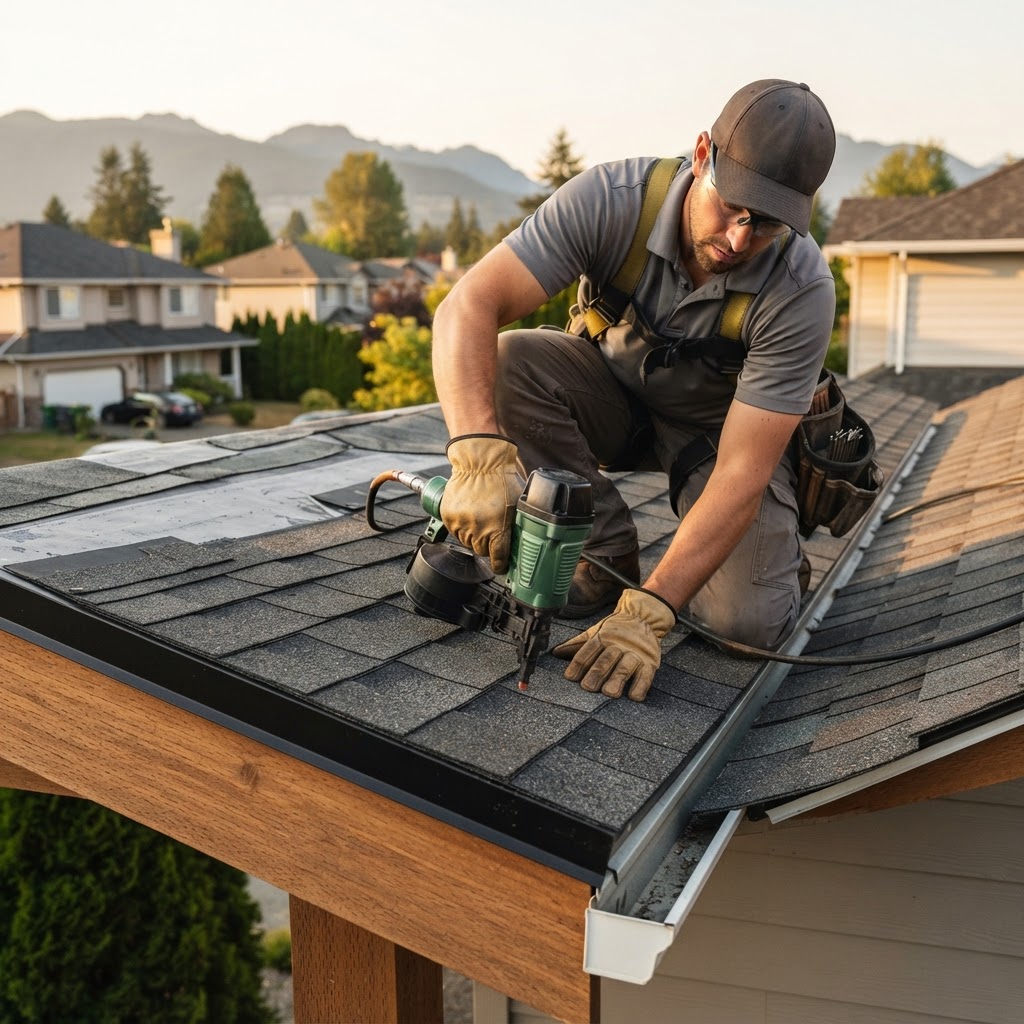
The roof geometry of your home also plays a significant role in how wind loads are distributed across the structure. Steep-slope roofs with a pitch above 6:12 experience different pressure zones compared to low-slope designs, and the corners and ridgeline are always the highest-risk areas for uplift. The BC Building Code requires that these pressure zones be accounted for in the structural design, which is why a qualified roofing company in Surrey will always assess the specific roof geometry before selecting fastening patterns and underlayment systems. For homes with complex rooflines featuring multiple valleys, hips, and dormers, the fastening schedule at each transition point needs careful attention to ensure there are no gaps in uplift resistance across the entire assembly.
Beyond fastening, the choice of underlayment contributes significantly to overall wind and moisture performance. Self-adhered underlayments, commonly called ice-and-water shield, are required under the BC Building Code at the eaves and in all valley areas, and many Surrey homeowners we work with choose to extend this coverage further up the roof deck for added protection during extreme rainfall events. A synthetic felt underlayment over the remainder of the deck provides a secondary moisture barrier if shingles are ever compromised by wind. If your current roof was installed more than 15 years ago, there's a real chance the underlayment has degraded and may no longer provide meaningful protection - this is one of the key things our inspectors check during a site visit. You can read more about how these principles apply to related projects in our post on Roof Replacement & Reroofing.
How to Prepare Your Home for Reroofing in Surrey
Getting your home ready for a reroofing project is straightforward once you know what to expect, and a good roofing company in Surrey will guide you through every step of the preparation process. The first thing we ask homeowners to do is clear the area around the perimeter of the house - move patio furniture, potted plants, outdoor toys, and any vehicles away from the work zone. Old shingles and underlayment will be torn off and dropped directly into a bin positioned beside the house, and flying debris can damage items left nearby. Most reroofing projects on a standard Surrey home take between one and three days from tear-off to final cleanup, depending on the roof size, pitch, and complexity of the design.
Inside the home, it's worth taking a few simple precautions before the crew arrives. We always recommend removing any fragile wall decorations or artwork, because the vibration from nailing can cause frames to shift or fall. If you have items stored in the attic, it's a good idea to cover them with an old sheet or move them away from the eave areas, as dust and debris can filter through during the tear-off phase. Letting your immediate neighbours know about the project is also a neighbourly thing to do - reroofing is noisy work, and a quick heads-up avoids any hard feelings. These small steps make the whole process smoother for everyone involved and help us get the job done efficiently without interruptions.
The timing of your reroofing project matters more than many homeowners realise. Surrey's weather window for ideal roofing conditions runs roughly from late April through October, when temperatures are consistently above 10 degrees Celsius - the minimum temperature at which asphalt shingles will properly seal their adhesive strips. That said, we do complete reroofing projects year-round in the Lower Mainland using cold-weather techniques and materials rated for lower temperatures. The BC Building Code's requirement for a standard 4:12 pitch on asphalt shingle installations and the 1:300 attic venting rule both remain in effect regardless of the season, so our installation process stays consistent throughout the year. If you're planning ahead, spring and early summer bookings tend to fill up quickly - get your free quote early to secure your preferred timeline.
Choosing your roofing material ahead of time also helps keep the project on schedule. Asphalt architectural shingles are by far the most popular choice in Surrey for their combination of cost-effectiveness, durability, and ease of replacement, but cedar shakes and concrete tile are excellent options for homeowners who want a distinctive look and are prepared for the associated maintenance requirements. We'll walk you through the pros and cons of each material during your consultation, including how each performs against Surrey's annual rainfall totals and moss growth conditions. Our services cover asphalt reroofing, cedar-to-asphalt conversions and torch-on flat roofs, and we're happy to discuss the options that suit your home's structure, your budget and your long-term goals. For related guidance on what reroofing typically involves financially, our post on Roof Replacement Cost in Vancouver is a useful starting point.
How often should a roofing company in Surrey inspect my roof?
What is the best material for reroofing in Surrey's rainy climate?
How does professional moss treatment extend the life of my cedar or asphalt roof?
What are the BC Building Code requirements for roof venting and pitch?
Why is regular gutter cleaning and repair crucial for homes in the Lower Mainland?
Choosing the right roofing company in Surrey is one of the most important decisions you'll make for the long-term health of your home. Surrey's climate is demanding - with rainfall exceeding 1,500 mm annually, persistent humidity, seasonal wind events, and relentless moss growth - and your roof needs to be installed by a team that understands these specific challenges and works to recognised standards like the RCABC Roofing Practices Manual. At Red Maple Roofing, we bring hands-on experience, genuine technical knowledge of BC Building Code requirements, and a commitment to quality workmanship on every reroofing, repair, and maintenance project we take on across Surrey and the Greater Vancouver area. If your roof is due for an inspection, showing signs of wear, or you're ready to plan a full reroof, we'd love to hear from you. Call us today at (778) 239-1701 or request your free quote online - we're here to help you protect your home for the long term.