Get a No-Obligation Quote
We respond within 2 hours during business hours.

By the Red Maple Roofing team in Coquitlam. Reviewed for accuracy by Rasheed, Founder & Lead Estimator, Red Maple Roofing.
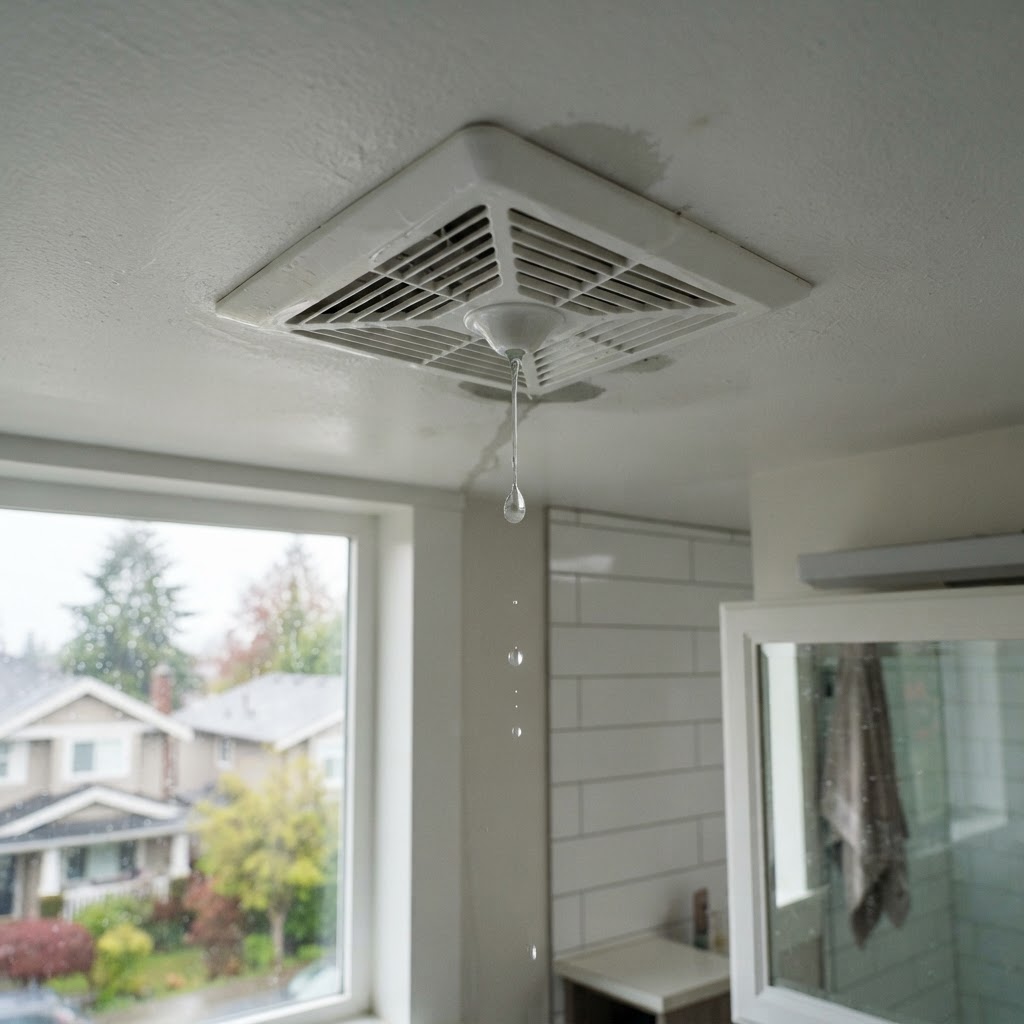
Finding water dripping from bathroom fan when raining is a common frustration for homeowners in the Lower Mainland. This issue typically occurs because of an external breach in the roof vent cap or because moisture is condensing inside cold, uninsulated ductwork. With our region seeing roughly 1,200 mm of precipitation annually, these leaks can quickly lead to bigger problems if they are ignored. Addressing the root cause early prevents water damage to your ceiling, insulation, and framing.
- Water dripping during storms often indicates a damaged roof vent or failing flashing.
- Drips after hot showers usually point to condensation in uninsulated ducting.
- Never climb your roof to inspect; use ground-level observation or contact our team.
- Proper venting and regular roof maintenance are essential for preventing moisture buildup.
Why is water dripping from your bathroom fan when raining?
When you notice water dripping from your bathroom fan when raining, it is almost always the result of external water intrusion through a damaged vent component or internal condensation gathering in your ducts. If the dripping happens only during heavy downpours, it is a strong indicator that your roof vent cap is compromised or the surrounding rubber boot has cracked. Conversely, if you notice the dripping in cold weather after running the shower, the warm air is likely hitting the cold, uninsulated pipe, causing water to condense and run back into your home.
According to industry guidance, bathroom fans are meant to exhaust moisture outside the home, not into the attic. If the ductwork is improperly installed or lacks insulation, the temperature differential during our damp winters will lead to significant moisture accumulation. We often find that older homes in areas like Coquitlam have ducts that simply end in the attic, which is a major violation of proper ventilation standards. This trapped humidity is exactly what causes attic rain.

When we perform roof repair in Coquitlam, we pay close attention to how these vents are flashed into the roof deck. A failure in the pipe flashing allows water to follow the duct directly into the bathroom. In some cases, a simpler fix like replacing a dried-out rubber boot can solve the problem without needing a full roof overhaul. We prioritize honest evaluations, so if a minor repair is all you need, that is exactly what we will recommend.
If water is entering your home specifically when it storms, the problem is rarely the fan unit itself. The source is almost always a failure of the exterior weatherproofing at the roof penetration point.
Identifying the source: Rain vs. Condensation
The most effective way to distinguish between a roof leak and condensation is to monitor when the dripping occurs in relation to the weather and your daily activities. If you see water coming down only during active rain, you are likely looking at an external roof breach; if the dripping follows a hot shower on a freezing day, it is almost certainly condensation.
As explained in expert articles on ventilation, the temperature shift is the primary culprit for interior moisture. When hot, humid air from your bathroom travels through a duct running through an unheated attic, it rapidly cools. This causes the water vapour to turn into liquid, which then pools in the low points of the flexible ducting. This is why you might hear a sloshing sound or see water pour out when you turn the fan on.
If you are unsure about the cause, you can request a free quote for an on-site inspection. Our team looks for specific markers of both issues. When we check an attic, we look for signs of rust on the metal fasteners or staining on the wooden trusses surrounding the vent. If the insulation around the vent is wet, it confirms the duct is not sealed properly and is leaking warm air into the attic space, compounding the condensation issue.
To help you narrow down the issue, check these indicators:
Safe steps for homeowners to investigate
Homeowners should never climb onto a wet roof to inspect for leaks, as the risk of a fall is simply too high. Instead, you can safely gather useful information from the ground or by accessing your attic crawlspace during the day.
From the ground, use binoculars to scan the area around the vent pipe. You are looking for obvious gaps in the flashing or missing shingles that might be letting rain seep in. If you can safely enter your attic, look for water stains on the roof deck or mold growing near the fan housing. These signs are often the smoking gun for a ventilation system that is failing to move air effectively to the outside.
For more detailed guidance on how to find a leak from inside your house, you can read our guide on how to find a roof leak from inside. It covers the most common pathways water follows once it breaches the shingle layer. Please remember that if you find evidence of active water intrusion, it is better to call a professional for a proper assessment before the damage to your drywall or electrical system worsens.
We are WorkSafeBC-registered and carry full commercial liability insurance to handle these repairs safely. Whether it is a quick fix for a cracked boot or a more involved repair to your attic venting, we provide an itemized written quote after an inspection. We don't believe in pressure or selling you work you don't actually need.
What our roofers check during an inspection
When we perform a professional inspection to identify why you have water dripping from bathroom fan when raining, we start by examining the external integrity of your roof vent caps and rubber pipe flashings. Our goal is to determine if the moisture ingress is originating from a compromise in the roofing system itself or from thermal-related interior condensation.
During our site visit, we look closely for gaps in the flashing, cracked rubber boots around the duct penetration, and damaged damper flaps that may be stuck open. We also check the surrounding shingles to ensure no water is tracking along the roof deck, as this often indicates that the seal between the duct and the roof surface has failed. You can learn more about how we evaluate these issues in our guide on roof inspection in Vancouver.

- Integrity of the rubber pipe flashings and vent boots
- Condition of the roof vent cap and damper functionality
- Signs of water tracking or staining around the duct penetration on the roof deck
- Overall condition of nearby shingles, including any cracked or lifted tabs
After completing our on-site evaluation, we provide an itemized written quote to address any identified leaks. Whether you need a simple pipe flashing replacement or more extensive roof repair, our team ensures you have a clear understanding of the necessary steps. We take pride in our transparent approach and will never recommend unnecessary work, as our reputation is built on honesty.
Preventing future moisture issues
Proper ventilation is the most effective way to prevent long-term damage to your home structure, particularly given the high precipitation levels we experience in the Lower Mainland. Ensuring your bathroom fan duct terminates directly outside is a critical step in mitigating the risk of attic moisture and interior water accumulation.
We strongly recommend that all exhaust ducts passing through unconditioned attic spaces are properly insulated to prevent the cold-weather condensation issues described at MoistureFlow. If you discover moisture buildup in your attic, you can find helpful advice in our post about frost in your attic, which details how to distinguish between roof leaks and condensation.
For ongoing peace of mind, our maintenance plans are designed to keep your roof and ventilation systems in optimal condition year-round. Investing in regular upkeep helps identify minor issues before they become costly repairs, as outlined in our roof maintenance checklist.
- Basic Plan - $399/yr
- Premium Care Plan - $899/yr
- Complete Protection Plan - $1,399/yr
If you are concerned about the state of your ventilation or roof integrity in areas such as Coquitlam or Vancouver, please contact us for a free quote. Our team is fully insured and WorkSafeBC-registered, and we provide a 15-year written workmanship guarantee on our repairs.
Is it normal for my bathroom fan to drip when it rains?
How do I know if my bathroom fan leak is condensation or a roof leak?
Can a leaking bathroom fan cause mold in my attic?
Should I go on my roof to fix a leaking bathroom vent?
How can I prevent condensation in my bathroom exhaust duct?
If you continue to experience water dripping from your bathroom fan when raining, do not wait for the next storm to act. Protecting your home from water damage is our priority, and our team at Red Maple Roofing is ready to help with professional inspections and repairs. Call us at (778) 239-1701 to book your site visit today.